
Who We Help · Print & Sign Shops · Tax Services
Print and sign shop tax services: HST on everything, and equipment that shapes the T2
A print or sign shop has no exempt-supply puzzle to solve. Design, production, installation, and trade printing are all fully taxable. So the GST/HST question is almost always about input tax credit recovery, not eligibility. The T2 problem is different. A press, plotter, or CNC router purchase can swing taxable income by tens of thousands of dollars in the year it lands. Instalments built on last year’s numbers stop matching the business the moment equipment changes.
By the AnalytIQ Accounting team · Last reviewed: September 12, 2026
At a glance · print and sign shops
Not sure which applies to you? Get a free proposal or book 15 minutes.
HST is simple here — the real work is claiming every input tax credit
Design services, printed product, signage manufacturing, and installation labour are all standard taxable supplies at the applicable HST rate. There is no exempt or zero-rated category to sort out for domestic sales. There is also no split-supply headache the way there is in health care or education. That simplicity means the return itself is rarely the risk — missed input tax credits are. Substrate, ink, hardware, equipment purchases and leases, shop rent, and even the HST paid on imported machinery all generate ITCs. Shops that do their own bookkeeping in spreadsheets routinely leave some of it unclaimed. That is because the paper trail was never captured cleanly at the time of purchase.
CCA on presses, plotters, and CNC routers
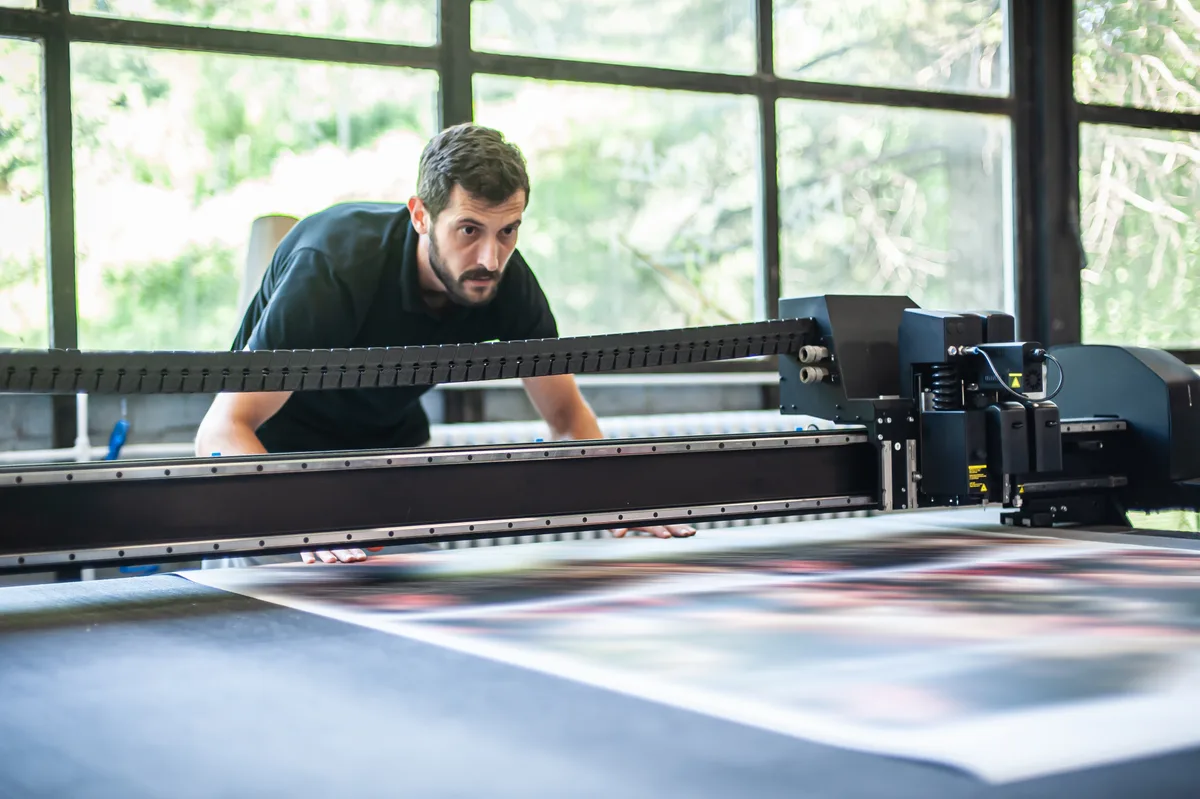
Equipment used directly to manufacture or process print and sign product for sale generally falls into CCA Class 43, depreciated at 30% on a declining-balance basis. Older or specialized equipment sometimes sits in a different class. We confirm the correct classification rather than assume it. As at the time of writing, the federal immediate expensing incentive lets an eligible Canadian-controlled private corporation write off qualifying equipment purchases up to an annual limit. That write-off happens in the year of acquisition, rather than spreading the deduction over years. That can matter a great deal for a shop replacing a press or adding a CNC router. The rules and dollar limits have shifted before and should be confirmed against the year of purchase, not assumed from a prior year's return.
| Purchase | Tax handling to check |
|---|---|
| New large-format printer or plotter | CCA class, immediate expensing eligibility, ITC on HST paid or self-assessed at import |
| CNC router or laser cutter | Same class review; confirm whether it is leased or financed before booking CCA |
| Delivery or install vehicle | Passenger vehicle CCA and ITC limits versus a commercial vehicle with none |
The T2 and instalments in an equipment-heavy year
Ontario's combined small business rate applies to active business income up to the $500,000 threshold. A shop's taxable income can move sharply from one year to the next. A year of steady operating profit can be followed by one that carries a large CCA deduction or immediate expensing claim on new equipment. We recompute instalments when a major purchase is planned, rather than letting the CRA's prior-year-based instalment reminder run on autopilot. Overpaying instalments on income that a big equipment write-off is about to erase ties up cash. That cash is usually needed for the down payment itself. The same review catches the opposite problem — a shop that under-instalments in a strong year with no offsetting purchase and faces arrears interest at year-end.
Wholesale and trade printing does not change the HST answer
Billing an ad agency or another print shop for trade work is still a fully taxable supply. There is no wholesale exemption or reduced rate in the Excise Tax Act for business-to-business printing. What changes is documentation. Trade invoices should clearly identify the billed party and the work performed. That way, on the rare occasion CRA reviews a shop's ITCs or output tax, the invoice trail supports exactly what was sold and to whom.
Deposits and progress billing affect when tax is actually owed
GST/HST generally becomes payable on the earlier of the invoice date and the date payment is received. So a deposit collected months before a large custom job is finished can trigger a reporting obligation early. That obligation lands well before the job's revenue would otherwise land on the income statement under normal accrual timing. Shops filing GST/HST monthly or quarterly need that deposit captured in the correct filing period, not the period the job is finally delivered. A mismatch here is one of the more common review triggers we see. It happens when a bookkeeping system and a tax filing calendar are not talking to each other. We reconcile deposits, progress billings, and final invoices to the return every period, rather than treating GST/HST as a once-a-year exercise. Shops selling finished product to US customers should see our cross-border tax page for print and sign shops. It covers when a shipment genuinely qualifies as a zero-rated export versus when it does not. The full corporate tax file runs through our tax services practice on the same fixed-fee basis as everything else we do.
What we take off your plate
Tax services for print and sign shops, handled.
- Every input tax credit claimed since printing carries no exemption
- CCA class and immediate expensing checked on every new press or plotter
- T2 and owner T1s filed together, deadlines tracked
- GST/HST returns and instalments handled
- CRA letters and reviews answered for you
- Salary-versus-dividend plan reviewed every year
Mistakes we fix
Three things that go wrong for print and sign shops.
- Lumping every job into one revenue account instead of costing substrate, ink and press time per order
- Zero-rating a US sale when the customer’s own courier picks up the job in Canada
- Missing the immediate expensing incentive on a new press, plotter or CNC router purchase
Recognise one? Book a call and we will tell you what it is costing you.
Services for print and sign shops
Six services, one team that knows how print and sign shops run.
Start with one. Add the rest when it makes sense; the books, payroll and tax already talk to each other.
Free proposal
A fixed fee for your tax work, in writing.
- Tell us about your business. The form takes about a minute.
- A short discovery call. Fifteen minutes to confirm what you need.
- A fixed fee in writing. We reply within one business day. No hourly surprises.
- Canadian and US filings under one roof
- Cloud-first: QuickBooks Online, Dext, Wagepoint
- Brampton, Ontario, with clients across Canada and the US
Related answers
Browse all 200 answers.
Common questions.
Do we charge HST on printing we do for another print shop or an agency?
Yes. Trade and wholesale printing is a fully taxable supply just like retail work; there is no business-to-business exemption in the Excise Tax Act for printing services.
What CCA class does a new large-format printer fall into?
Most equipment used to manufacture or process print and sign product for sale falls into Class 43 at a 30% declining-balance rate. We confirm classification case by case, though, since some equipment sits elsewhere.
Should we time a big equipment purchase around our fiscal year-end?
Often it is worth discussing before you commit. CCA and any available immediate expensing on the purchase can materially change this year’s taxable income and next year’s instalment base.
Related reading
Tax filed around your press schedule, not a template.
Book a consultation and get a plain answer on exactly what applies to you.